these moments, messages, and spaces continually interest me. This site exists as a meditation on the book and its power to transform itself along with readers, writers, and listeners.
these moments, messages, and spaces continually interest me. This site exists as a meditation on the book and its power to transform itself along with readers, writers, and listeners.
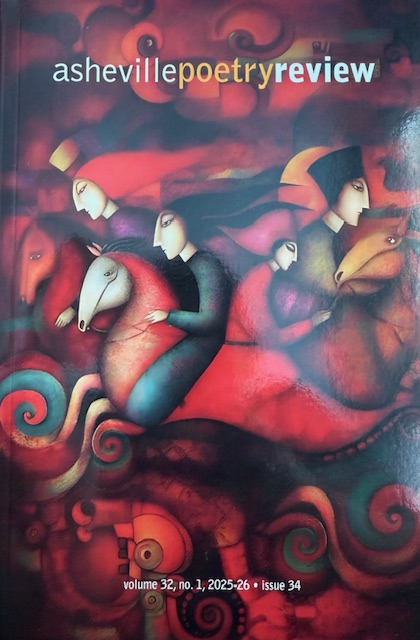
A poem of mine appears in the latest issue of Asheville Poetry Review. “Dickens in Manhattan” comes out of my experience of reading Dickens’s travelogue about the US, American Notes, while living in Tennessee. I originally conceived of this poem as a pastoral, a poetic mode I was focused on at the time.
The poem begins in New York as described by Dickens and then enters the South to find a new landscape.
…To rise means
falling with upstanding scum, superior-
seeming, well-dressed nothing. To speak
of this mirror’s wrong. I must trust
it will crack and I’ll slip through.
Thank you, Editor and Founder of the Asheville Poetry Review, Keith Flynn, for including my work in what will be the last issue of this legendary journal.
6.13.2026
Two poems of mine appear in the new issue of Midway Journal. One poem, “Paradise,” moves through sleepless nights and memory, while the other, “Host Community,” explores a landscape transformed by corporate tricks.
Thank you to poetry editor, Samantha Sharp, and all the editors at Midway.
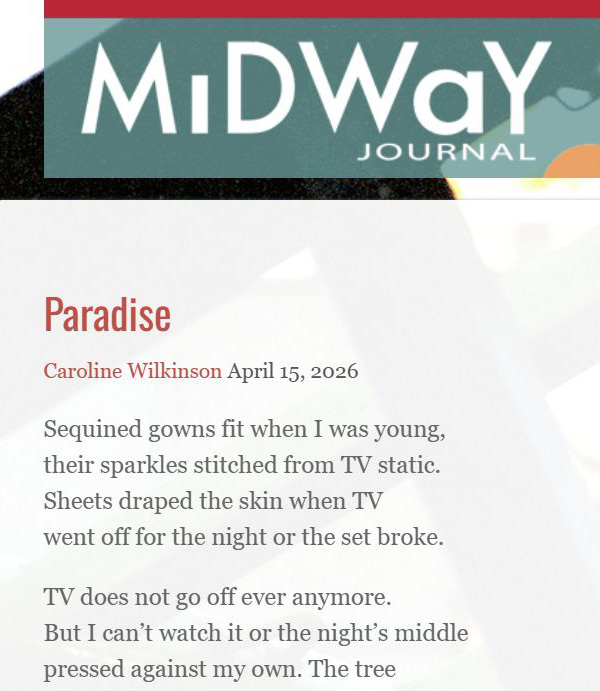
Read the full poem, “Paradise.”
4.22.2026
In May 2007, I wrote about an Iranian novel by Simin Daneshvar, Savushun. I initially read the book to learn about Iran, which my government had identified as part of an “axis of evil.” The US had already bombed and invaded another country on this axis, Iraq, without provocation.
I would recommend Savushun to anyone. Daneshvar brilliantly renders Iran during World War II through the lens of her heroine’s expansive and beautiful consciousness.
3.25.2026
I had the honor of appearing on a panel on nineteenth-century literature with Dr. Christina Jen from Southern University and A&M College last September. The panel took place at the SCMLA Conference in New Orleans, a city I had never visited. My paper was on the influence of housing segregation on the construction of the heroine’s innocence in Henry James’s The Portrait of a Lady. The presentation drew upon elements of my recent article published in Novel on the Underground Railroad and James’s masterpiece.
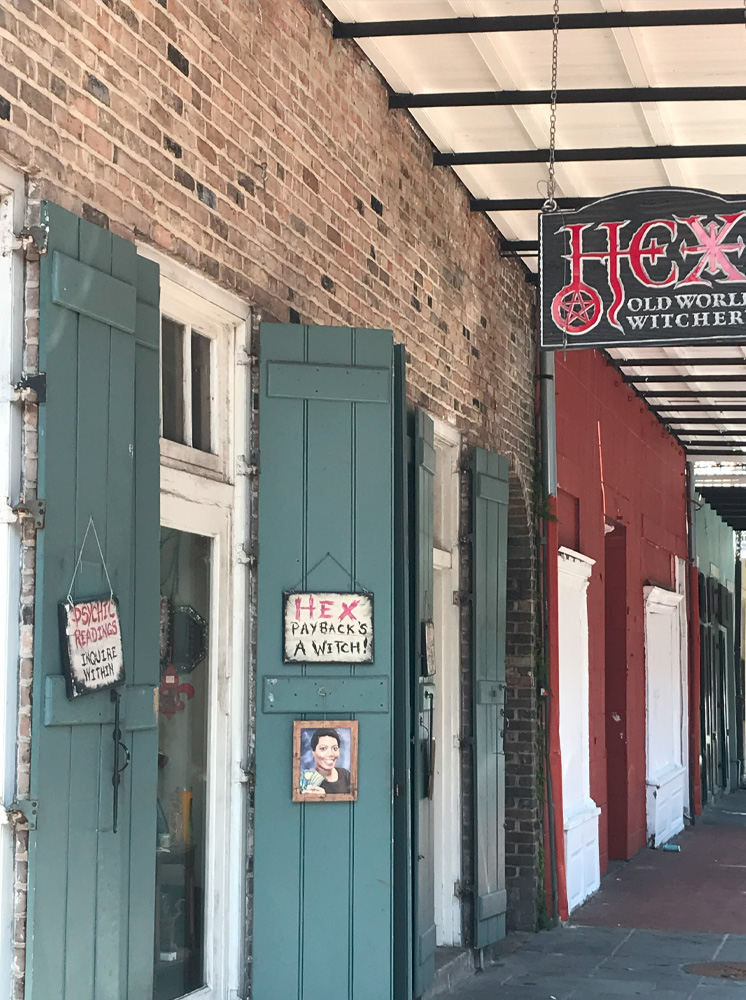
Not long after posting about the conference on Instagram, I deleted my (relatively new) account, wanting nothing to do with the platform’s anti-LGBTQ bent. The picture from the post, which I took while wandering in amazement in New Orleans, appears above.
1.30.2025
Update on 5.30.2026: I am now on BlueSky.
A video poem of mine appears in the new issue of Drunken Boat. Formally, this poem is what I’d call a Tennessee crown. Unlike a proper, contemporary crown of sonnets, such as Patricia Smith’s stunning “Motown Crown,” my Tennessee crown turns with the spirit of the jester, moving through the gallows humor of healthcare workers.
Thank you, editors of Drunken Boat, for including me in this issue of one of my favorite online journals.

For more of my video work that originally appeared in Drunken Boat, see “Lettie from the Ocean,” an interactive piece designed for the iPhone.
3.13.2024
The online journal, Drunken Boat, will celebrate the launch of its newest issue with a virtual party on Tuesday, March 12 at 8:00 PM eastern time. At the launch event, contributors including me will read work from this exciting issue.
I am so honored to be included in the latest Drunken Boat, now edited by students at Tufts University under the guidance of Founding Editor, Ravi Shankar, and the Director of The NEXT, Professor Dene Grigar.
To join the launch party, follow the Zoom link: https://tufts.zoom.us/j/3481482573

3.11.2024
This week I had the opportunity to read with my fellow contributors to the wonderful recent issue of Washington Square Review. Organized by editor Melissa Ford Lucken and Dave Wasinger, the reading was a true pleasure to experience as a reader and listener.
You can find the recording of the event here. My own contribution is around the 1:28:14 mark.
Many thanks to Melissa and Dave and all the editors at Washington Square Review.
10.25.2023
Please join me on Monday, October 23 at 7:00 PM EST, for a reading of work from the most recent issue of Washington Square Review. I have three poems in this issue, available for purchase here, edited by Melissa Ford Lucken. I will be reading with many of my wonderful co-contributors.
You can register here for the Zoom link.
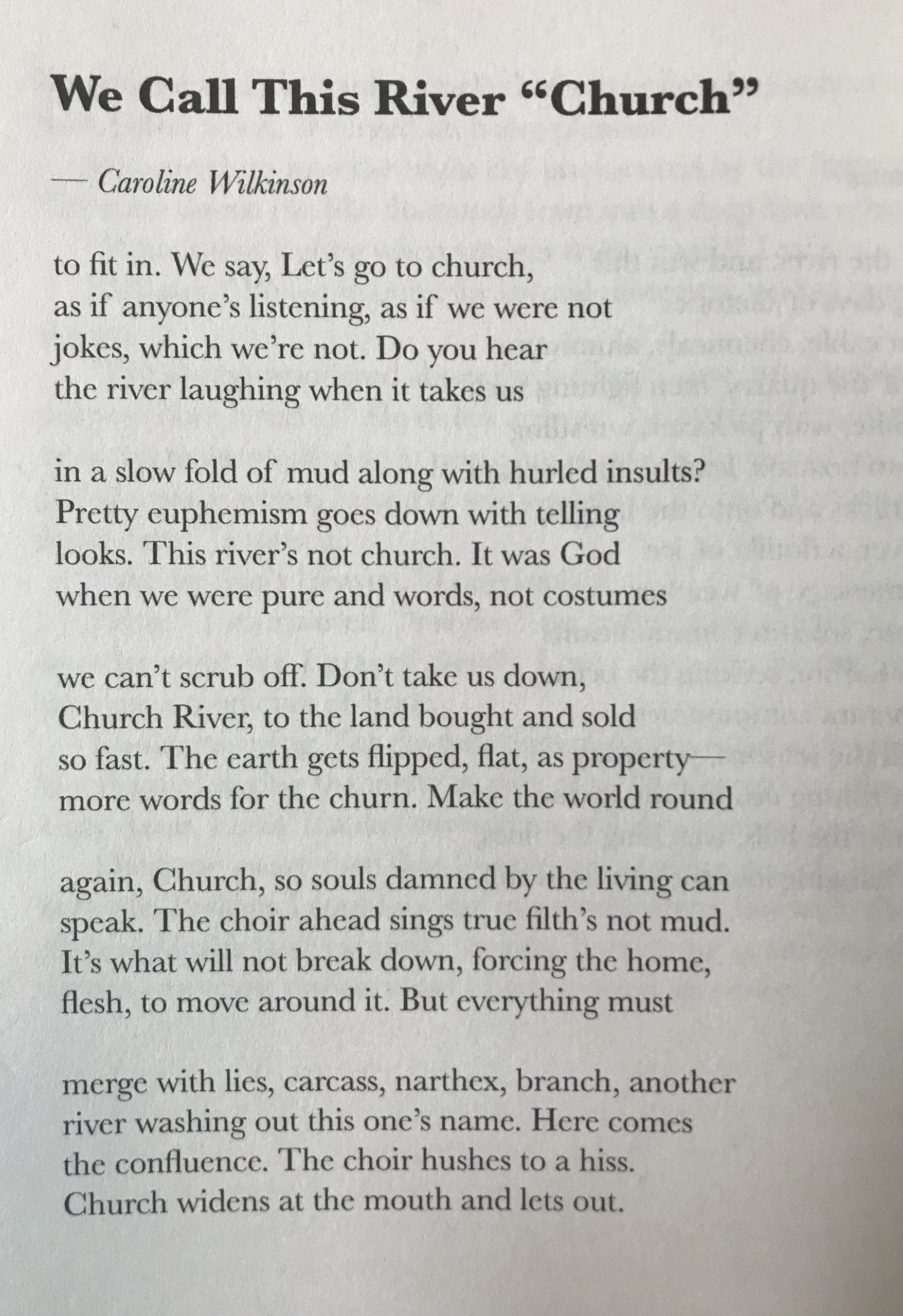
Below is one of my poems published in the issue, “We Call This River ‘Church’”:
10.17.2023

My article on the influence of the Underground Railroad on the plot of Henry James’s The Portrait of a Lady appears in the most recent issue of NOVEL: A Forum on Fiction. The article focuses on a house in the narrative that James famously based on his grandmother’s home in Albany, New York. This grandmother, Catharine James, lived near numerous stations on the Underground Railroad.
While The Portrait of a Lady features an unusual number of grand homes, the Albany house is not one of them. One critic, Marilyn Chandler, characterizes the home as an “architectural joke” compared to the other houses in the novel. When Isabel first meets the aunt who takes her out of Albany to Europe, this aunt, Mrs. Touchett, calls the home “very bad” and “bourgeois.” (Mrs. Touchett lives in a more typical house in the world of The Portrait of a Lady, an Italian castle.)
I argue that the “very bad” house in Albany operates as a spatial representation of the novel’s plot — or to use the term preferred by James, the novel’s “ado.” In the preface to The Portrait of a Lady, James calls the word plot “nefarious” before reflecting on the process of creating an “ado” for Isabel in terms that evoke the “square” and “large” Albany house. He metaphorically describes constructing the novel’s narrative action as building a “square and spacious house” around his isolated heroine. Isabel when staying in Albany remains notably isolated, choosing to be alone. She consistently appears in a room whose door to the “vulgar street” is bolted shut and “condemned.”
In my analysis of the Albany house as a symbol of the novel’s plot, I consider the history of the upstate city in different decades, including the 1850s when Isabel daydreams in front of the bolted door and the Underground Railroad was particularly active in Albany. I ultimately assert that the history of Black people in the US crossing regional and national borders in the 1850s in pursuit of freedom centrally and problematically determine James’s highly influential plot about an innocent, white American woman travelling to Europe in search of personal freedom.
To read the article, please visit NOVEL‘s site. If you cannot get past the paywall, you can download a pdf of the article at Academia.edu.
10.12.2023

In the new issue of Menagerie Magazine is a short piece of mine, “Panicle.”
Thank you, Steve Woodward, co-founder and editor of Menagerie for including this story about the strange joys of exclusion.
4.11.2023